You earn more than your parents ever did. So why does your bank account look the same as theirs?
The problem isn't your income. It's that nobody taught high earners what to do differently than everyone else. Earning more without a system just means spending more.
of people earning $250K–$500K say they live paycheck to paycheck.
Source: 2025 Goldman Sachs Asset Management Retirement Survey
You know the moment. You're at dinner and someone mentions their investment portfolio. Their kid's college fund. The rental property they just closed on. And you sit there with your wine, nodding, while silently calculating whether you can cover next month's mortgage and the car payment and the credit card bill that seems to grow no matter what you do.
You make good money. Maybe great money. But you have no idea where it goes. The Uber Eats receipts. The subscriptions you forgot exist. The lifestyle that inflated so gradually you didn't notice until you were running on a treadmill that costs six figures a year to operate.
"I make decent money, but no matter what I do, it feels impossible to get ahead."
Personal Finance Subreddit, 1,200+ upvotesThere's a name for this: HENRY. High Earner, Not Rich Yet. It's not a character flaw. It's a pattern. Consumer prices climbed 24.6% between 2020 and 2025. Your salary went up, but so did the cost of looking like someone who makes that salary. And nobody handed you a playbook for the difference between earning more and actually keeping more.
The financial industry doesn't help. Dave Ramsey talks to you like you're 22 with your first credit card. Kiplinger assumes you already have a brokerage account. Morning Brew gives you headlines, not a plan. Nobody is speaking to people who earn plenty but save nothing with practical guidance and zero judgment.
Not a guru. Not a broker. A writer.
Joshua Becker is a New York Times bestselling author and the founder of Becoming Minimalist, read by over 2 million people. He's written five books on the relationship between what we own, what we spend, and what actually matters.
He doesn't sell finance courses. Doesn't pitch investment products. Doesn't claim to have a "system" that makes money while you sleep. He writes a quarterly magazine about money that treats readers like adults.
That's it. That's the whole pitch.

Willpower fades. Systems don't.
Every 90 days, you get a new issue. Not because you need more information, but because drift is real. Habits decay. Spending creeps back. A quarterly reset catches the slide before it turns into a year of regret.
Most financial advice treats money like a project. Something you fix once and forget. But your spending has a gravitational pull. Without a consistent force pulling you back, the drift wins every time.
From Earning Well to Actually Keeping It
The Dinner Table Dread
Someone mentions investments and you change the subject. Your portfolio is... nonexistent.
The Mystery Drain
$8K, $10K, $12K a month goes out. You're not sure where. You're afraid to look.
The 2 AM Math
Lying awake calculating whether you can cover the mortgage, the tuition, the credit card minimum. All at once.
The Fraud Feeling
People assume you have money because you earn money. You smile and say nothing.
The Quiet Confidence
You know exactly where you stand. The conversation about money doesn't make you flinch.
The Visible Flow
Every dollar has a destination. The leaks are patched. You see the full picture every month.
The Deep Breath
An emergency fund that actually exists. Real savings growing. The treadmill slowing down.
The Real Deal
Your income finally matches your net worth. You're building something, not just maintaining appearances.
People who found the leak. And plugged it.
Everything. Once. Forever.
One payment. No subscription. Lifetime access to every issue: past, present, and future.
Less than a single dinner out.
One payment. No recurring charges. The irony of a money magazine with no subscription fee is not lost on us.
Try It. If It Doesn't Work, You Pay Nothing.
Get lifetime access today. Dive into the issues. Use the bonuses. Give it 60 days. If you don't feel less stressed about money, if your finances aren't more organized, if you don't have a clearer path forward, one email gets you a full refund. No questions.
The Fine Print (There Isn't Much)
"I don't need a magazine, I need an accountant."
An accountant handles your taxes. This handles the mindset and habits that determine how much you actually have left to save, invest, and keep. Most high earners don't have an income problem. They have a clarity problem. Simple Money fixes that.
"I make too much money to need help with finances."
41% of people earning $250K–$500K are paycheck to paycheck (2025 Goldman Sachs Asset Management Retirement Survey). Income doesn't equal financial health. If your savings don't reflect your salary, you're in the exact right place.
What format is the magazine?
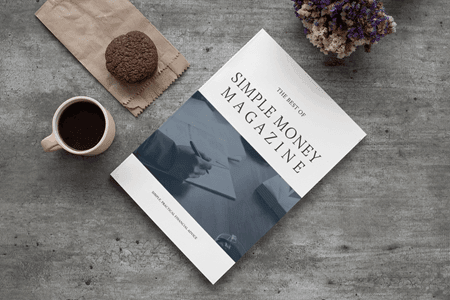
Simple Money is a digital magazine delivered to your email as a beautifully designed PDF. Read it on any device: phone, tablet, or computer. The physical book is a separate printed hardcover shipped to your door with free worldwide shipping.
What does "lifetime access" actually mean?
You pay once and receive every past issue, every current issue, and every future issue for as long as we publish. No renewals, no recurring charges, no hidden fees. If we ever stop publishing, you keep everything you've received.
Is this a subscription?
No. One-time payment. You will never be charged again. A money magazine that doesn't nickel-and-dime you. Imagine that.
$50 seems cheap. What's the catch?
No catch. One-time lifetime access is the entire point. No subscription drain. You get the full archive (31 issues), every future issue, the printed book, and three bonus tools. The goal is to help as many people as possible. Pricing reflects that.
Who writes the articles?
A mix of bestselling financial authors, certified financial planners, and real people who've turned their money situation around. Every article is selected by Joshua Becker and the Becoming Minimalist editorial team. No filler, no sponsored content, no ads.
You already earn enough. It's time to keep it.
One payment. Every issue. The tools, the system, the reset you've been putting off. Sixty days to decide if it's worth it.
Get Lifetime Access →P.S. The $50 lifetime price won't last. It costs real money to print and ship the book worldwide. Lock in before the numbers change.
P.P.S. My newest book just hit the New York Times Best Seller list. The same thinking behind that book drives every issue of Simple Money.
P.P.P.S. My wife Kim was orphaned at birth and immediately adopted. In 2015, we used the freedom minimalism gave us to start The Hope Effect, a nonprofit providing family-based care for orphans. When you pick up Simple Money, you're supporting a company that puts its values into action.
– Joshua Becker